
Polestar should borrow Chevrolet’s astronaut playbook, argues Sian Conway-Wood
As Tesla turns its Roadster into a stunt show, the behavioural scientist says Polestar could claim the cultural space Saab left behind by becoming the car clever people are known to drive.
Sian Conway-Wood, a behavioural scientist and senior managing partner, argues that Polestar has a chance to become the thinking person’s Tesla by reviving a Chevrolet marketing tactic from the 1960s, rather than competing with the spectacle Elon Musk has built around his brand.
Her starting point is the unveiling of Tesla’s long-awaited Roadster electric sports car, which drove upside down along a ramp, launched into the air and “performed what can only be described as a kickflip”. Musk also raised the idea of a looping track at Tesla’s Texas headquarters.
“It’s difficult to know whether we’re watching the future of automotive engineering or a billionaire attempting to recreate his childhood Hot Wheels collection,” she writes.
Conway-Wood says the display fits the brand world Musk has spent years building, mixing sci-fi, gaming, engineering that seems impossible and the kind of stunts that would have thrilled “a 12-year-old boy in 1998”. That cultural identity is coherent, she concedes, but it set her thinking about Polestar, which she believes has the opportunity to do something more interesting while Tesla is making cars fly.
The identity Saab left behind
She points to Saab, once known as the ‘thinking person’s BMW’. Jeremy Clarkson famously pictured the typical Saab owner as an architect of slightly leftfield taste wearing a black polo neck.
That stereotype was extraordinarily useful, she argues. Saab became linked with intelligent, independent and unconventional people who valued good engineering and were not especially bothered whether the neighbours recognised the badge. Owning one said something different from owning a BMW, even though the two cars did much the same job.
Cars, she writes, have always been among the most conspicuous ways people express identity. A Porsche signals ambition and performance, a Range Rover a certain relationship with luxury and status, and a Fiat 500 carries a quite different set of associations. Those meanings shift across generations and cultures, but people understand them and choose vehicles that match who they are, or who they would like to be.
Such identities do not line up neatly with demographic groups, she argues. A junior graphic designer and a senior structural engineer may live in very different economic worlds, yet both can value thoughtful design and unconventional ideas and share cultural reference points. The engineer might be weighing up a £70,000 car while the designer saves for a first second-hand hatchback, but both could recognise themselves in the same identity.
“The people who can afford a brand aren’t necessarily the only people who give it cultural meaning,” she writes.
Jaguar appears to have reached a similar view. Its managing director recently said that prospective customers who reacted well to the brand’s new electric GT had a shared appetite for individualism, even though they differed in age and income. Conway-Wood says Jaguar is wagering that people will pay a six-figure sum to express individualism, and that Polestar could make an equally compelling bet on a quieter version of it that does not need to announce itself.
Since Saab disappeared, she argues, no manufacturer has managed to take on the identity it vacated: independence of mind, a willingness to think differently and the quiet confidence of picking something because you grasp its value, whether or not everyone else recognises the badge.
In her view Polestar already has many of the ingredients, in its Scandinavian minimalism, engineering credibility and distinctive design language. “Its cars look like they were designed by people who think carefully about what they’re doing.”
That, she says, is a more interesting story than yet another debate about battery range, because functional advantages lose their value over time. A breakthrough soon becomes something buyers expect from every car in the category as competitors catch up, specifications converge and premium features become standard equipment.
The product still has to deliver, she adds, as cultural identity will not make up for an uncompetitive vehicle. “There are plenty of cars designed by clever people. Far fewer that have become culturally recognized as the cars clever people choose to drive.”
Astronauts in Corvettes
Her model is Chevrolet in the 1960s, when the space race had gripped America and the public was obsessed with astronauts. They stood for courage, intelligence, technical excellence and the ambition of the space programme, and they were becoming cultural celebrities.
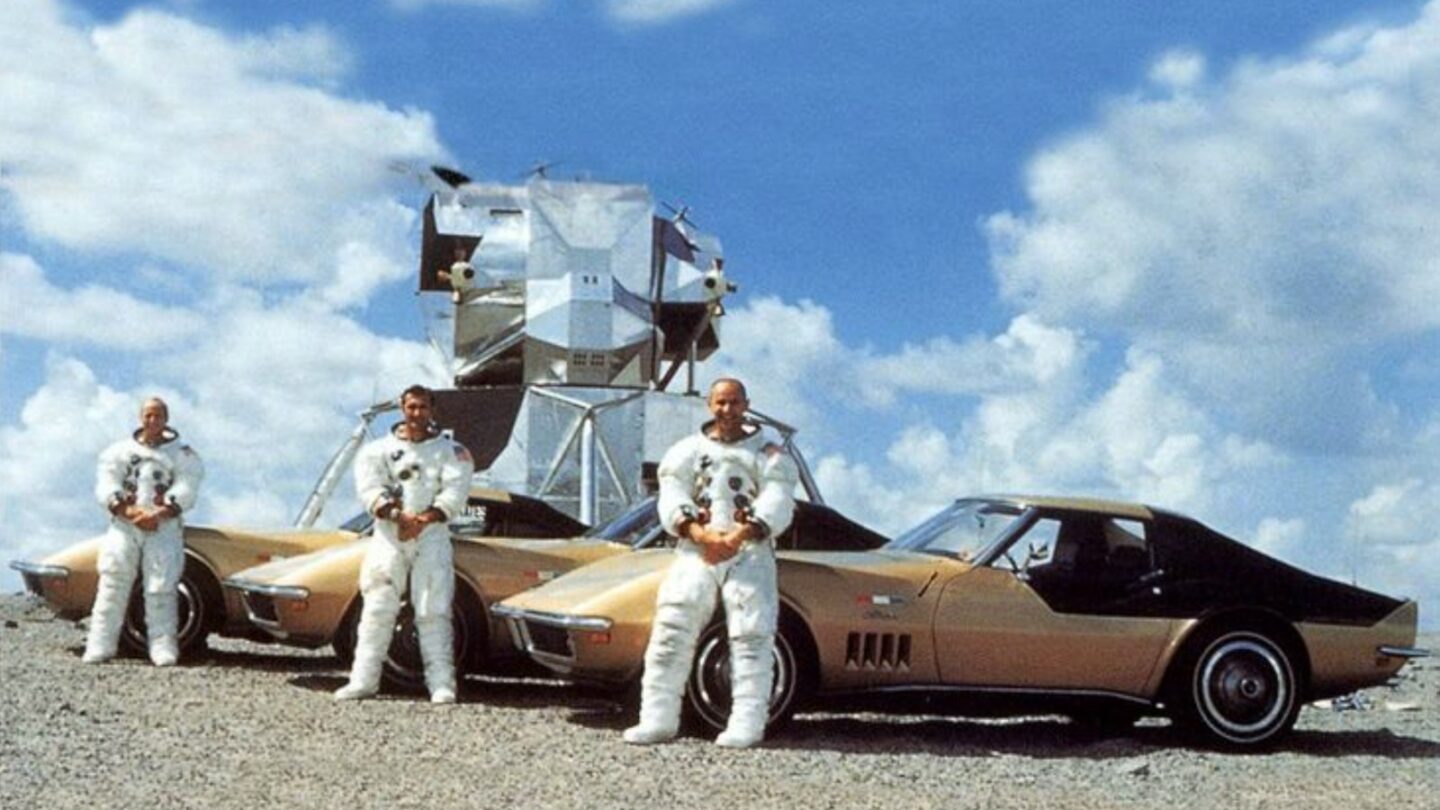
Jim Rathmann, who had raced cars before running a Chevrolet dealership close to Cape Canaveral, saw the opportunity and set up a deal under which astronauts could lease Corvettes for a nominal $1 a year.
The arrangement meant the people who embodied technological progress were driving an advanced sports car. Astronauts were photographed with the cars and drove them around Cape Canaveral, and the link became part of the imagery surrounding the US space programme. The Apollo 12 crew were famously pictured with matching gold Corvettes.
Nasa restricted astronauts’ commercial endorsements and the deal was not an official Nasa partnership, but Conway-Wood says the cultural link was still powerful. People did not need to be astronauts, or aerospace engineers, to want to feel connected to the qualities astronauts represented.
Hollywood later added to the mythology with ‘The Right Stuff’ and ‘Apollo 13’, she writes, and by the time ‘Armageddon’ came along audiences were happy to accept Bruce Willis leading a crew of oil drillers into space as a sensible way to stop the apocalypse. The astronaut had become a lasting symbol of courage, intelligence and ingenuity.
Chevrolet, she argues, spotted where cultural meaning already existed and worked out how to attach its product to it. Astronauts really did drive Corvettes, so the connection existed in the world, where others could see it, recognise it and give it meaning. Sixty years on, she believes Polestar could do something remarkably similar.
Status without shouting
Luxury car marketing has traditionally relied on familiar markers of status such as power, wealth, performance and exclusivity, she writes. Some buyers most want the thing everyone recognises; others prize what only certain people appreciate. She describes it as the difference between “look what I can afford” and “look what I appreciate”.
In her reading, Tesla has increasingly embraced technology as spectacle and Jaguar is chasing expressive, unmistakable luxury, which leaves Polestar room to occupy something quieter but no less aspirational: the confidence of someone who does not need to go for the obvious option, who pays attention to proportion, materials and detail, and who values innovation for what it makes possible.
She sees genuine commercial potential there, because a rival can match a brand’s specifications but cannot simply declare itself the car a particular cultural world has chosen. “That association has to be earned.”
The pitch to Polestar
Conway-Wood suggests Polestar could become linked with the people shaping the future, rather than those with the money to flaunt the present. She lists scientists developing new materials, engineers tackling the climate crisis, industrial designers making everyday objects extraordinary and researchers asking questions others have not yet thought of: interesting people who are not necessarily famous.
Where Chevrolet tapped into the Cold War era’s heroism, daring and technological ambition, she says Polestar could build an association with curiosity, discernment and independent thinking. Its Scandinavian approach to design, its engineering heritage and its understated look give it a credible starting point.
As a modern equivalent of Rathmann’s dollar-a-year lease, she imagines Polestars turning up regularly outside Cambridge research labs, or parked by the studios and workshops where the next generation of British designers are building reputations, driven by the people behind breakthroughs that will eventually benefit millions.
The aim, she writes, is to make the cars a normal part of daily life for people whose work reflects the qualities Polestar wants to stand for, and to do so in a manner that is genuine, visible and lasting. Rathmann’s astronauts were, after all, given extraordinarily favourable lease terms, and she draws a line between a brief appearance in an ad and a real association that people come across outside any campaign.
She argues the appeal would extend well beyond those professions. Admiring discovery does not require being a scientist, and appreciating ingenuity does not require being an inventor, in the same way that wanting a Corvette never required being an astronaut. If Polestar became recognisably the car clever people drive, everyone who admires those qualities would have a reason to identify with the brand, turning an understated design philosophy into a cultural identity people choose to express.
In her view, the most interesting car campaign of the coming years could be one that makes the drivers more culturally interesting than the vehicle. She tells Polestar she has a few ideas, adding: “And not one of them involves driving upside down.”
In this story

Digital Gossip
News, people moves, campaigns, deals and opinion from across the UK’s agencies, marketing, media and technology businesses, written and edited by the Digital Gossip newsroom.
Send us a tip