
Mid-priced brands must prove they are clearly better, argues Mark Ritson
Mark Ritson, former marketing professor, brand consultant and founder of MiniMBA, argues that NIQ data shows the UK's middle market being squeezed from both sides after years of price rises.
Mark Ritson, former marketing professor, brand consultant and founder of MiniMBA, argues that mid-priced brands in UK packaged goods are losing ground because every price increase amounts to a claim about value, and after years of food inflation too few have supported that claim.
He starts with Michael Porter, who as a young Harvard professor published Competitive Strategy in 1980. Ritson calls the book a slog with a title among the dullest in business history, but says a heading on page 41, ‘Stuck in the Middle’, has outlived almost everything else in it.
Porter offered companies three routes: cost leadership, differentiation or a focus on a narrower market. Marketers latched on to differentiation and have spent four decades searching for it.
Porter also warned of the risk of committing to none of the three: “The firm stuck in the middle is almost guaranteed low profitability.” Such firms, Ritson says, lose bargain hunters to the cheap operator and their best customers to specialists.
Mr Miyagi made the same point more plainly in The Karate Kid, he adds: stay on either side of the road and you are safe, but walk down the middle and you end up squished like a grape.
The middle is shrinking
Ritson points to NIQ's Consumer Outlook for 2027, published last Thursday. Mid-priced products still make up 49% of the value of UK packaged goods sales, but their share is falling.
Over a year the middle shed 1.7 percentage points, the sharpest drop in Western Europe. Premium products picked up 1.1 points and value products the remaining 0.6. No other market in the region saw the middle lose share both upwards and downwards.
The figure he considers most important is that 69% of British shoppers told NIQ they would prefer to save their money if a product is not clearly better. Ritson describes the phrase as plain and the test as a very fair one.
Shoppers do not want mid-market brands to be unique or purposeful or to take a stand, he says. They want to know why those brands cost more than the retailer's version on the shelf beside them, and increasingly nobody, including the brand manager, can explain it.
Money is tight, with more than four in 10 British shoppers saying they are poorer than 12 months ago. Even so, almost twice as much share moved up to premium as moved down to value. Julian Crane, UK managing director at NIQ, said: “Our data shows that British shoppers haven’t stopped spending – they’ve recalibrated.”
Ritson recalls Trading Up, written by Michael Silverstein and Neil Fiske in 2003, which argued that shoppers economise in some areas so they can treat themselves in others. Choosing own-label washing powder, for instance, lets them justify a box of Lindor chocolates in the same shop.
That matters, he argues, because whatever the “Ehrenberg-Bass induced mania about distinctiveness over differentiation”, it is differentiation that chiefly drives a price premium. Professor Sharp and colleagues are right to connect distinctiveness with market penetration, he says, but perceived differentiation is the only way a brand can hope to survive the cuts across the British middle.
How brands got here
When inflation arrived, Ritson says, big brands raised prices repeatedly and were right to. Marketers became good at price changes, and much of many brands' growth came from better margins on higher prices rather than from more unit sales. But too many pocketed the gains without doing much to justify them, and consumer uncertainty rose with prices.
“Marketers got lazy,” he writes. They leaned too hard on the discount button, then assumed they could keep pricing above inflation each year and bank the growth that produced.
All the while the supermarkets were biding their time. They boxed the brands in with a value range underneath, priced lower than any manufacturer could manage, and a premium tier above designed to look clearly better than the brand in between.
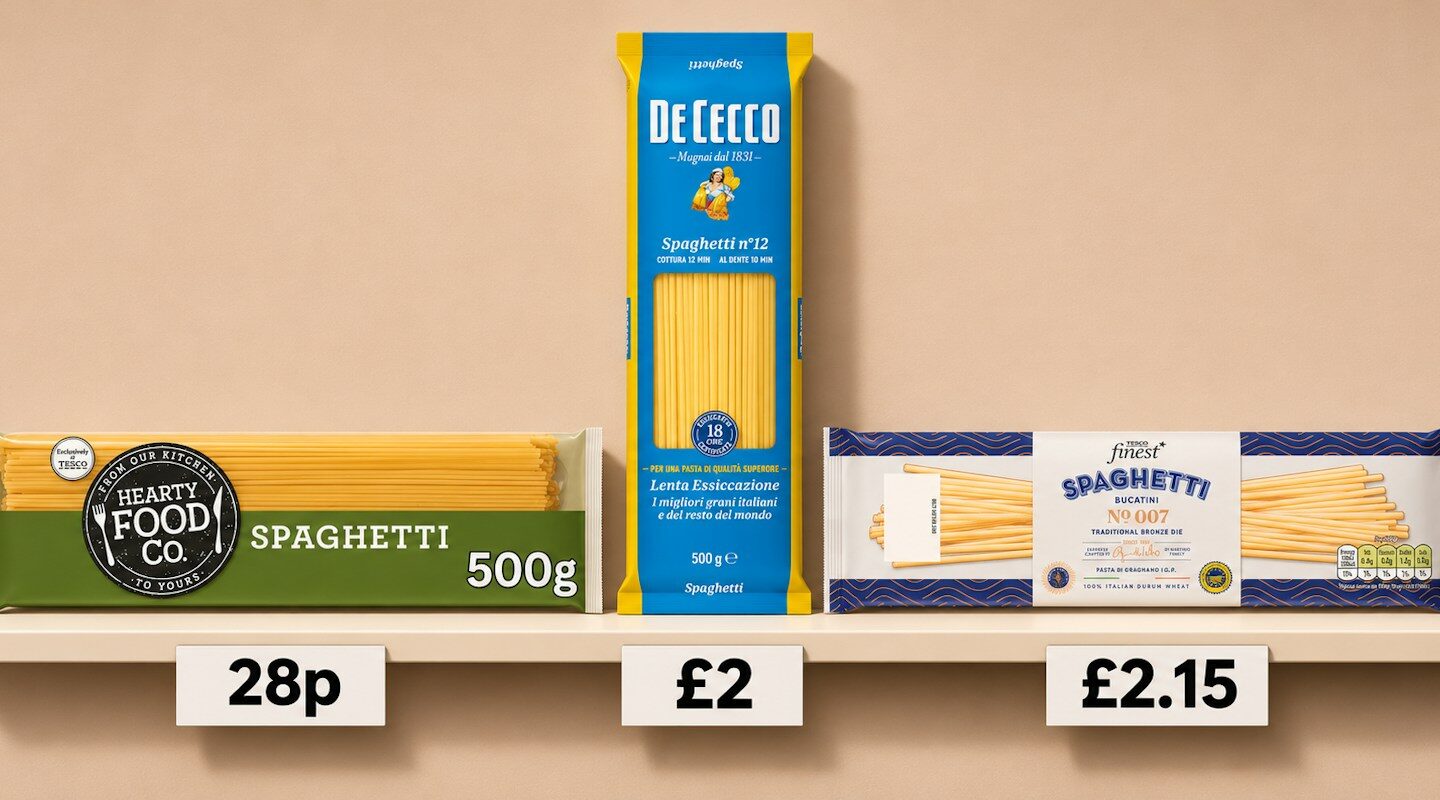
He takes the pasta aisle as an example. At Tesco, 500g of Hearty Food Co. spaghetti costs 28p, De Cecco spaghetti £2 and Tesco Finest bucatini £2.15: the same weight with three very different pitches. The cheap pack lets price do the work, while the Finest pack explains that bronze dies leave the pasta with a rough surface that sauce clings to.
Ritson questions what reason De Cecco gives shoppers to pick up its box, noting that the people selling the premium pasta also own the shelf.
He accepts that half the market remains in the middle and that a 1.7-point fall is no collapse. But the same loss every year for five years would take 49% to about 40%, and after 10 years the middle would be down to 32%.
Differentiation, properly understood
His advice is not to ignore what Ehrenberg-Bass teaches about distinctiveness, without which, he says, brands are “dead before the game begins”. But he rejects as dogma the idea that distinctiveness replaces differentiation. For the decade ahead brands need both, and they need to understand differentiation properly, something he argues most marketers, and Porter himself, got wrong.
In his view, marketers heard “differentiate” and went hunting for something unique, and when they failed to find it they compensated with PowerPoint, brand purposes and mission statements, overcomplicated work that failed to stick with consumers. He mocks the notion of toothpaste having a “mission”, ice-cream having a “vision” and a purpose for panty-liners. “Get over yourselves,” he writes.
Differentiation was only ever relative, Ritson argues. A brand needs to be slightly better than its rivals on one, or perhaps two, attributes that shoppers genuinely care about, and shoppers need to be aware of it. P&G calls this “irresistible superiority” and has organised most of the business around it.
Timing matters, he says, because budgets for 2027 are being approved this month. The easy reaction to a squeezed middle is a fresh round of deals and an overinflated positioning strategy, with retailers content to stand back and watch brands fail.
The harder route is to put time into proper positioning and money into product and advertising, so the brand is clearly better and worth the price. He stresses that advertising is a weak force and that marketers should start with product, “like a proper marketer would”.
Because that path is slower and more expensive, he expects most brands to avoid it in 2027, and the middle to keep shrinking.
With close to half of UK packaged goods spending still in the middle, Ritson says those brands have perhaps one or two years to show shoppers they are clearly better before the retailer settles the question for them.
In this story

Digital Gossip
News, people moves, campaigns, deals and opinion from across the UK’s agencies, marketing, media and technology businesses, written and edited by the Digital Gossip newsroom.
Send us a tip